
LAMMPS温控方法与速度重标定实操
NVE、Nosé–Hoover链、Langevin、CSVR/CSLD和两种温度松弛的完整输入与真实数据。
阅读本篇目录
选择恒温器时,要分清谁负责时间积分、谁只改变力或速度,以及目标温度是否应在每一时刻都精确相等。本文在鸢算科技集群实际运行了同一108粒子LJ模型的8种温度/积分配置,并配套GPU和Kokkos数值对照。
1. 下载、提交与统一模型#
mkdir thermostat-demo
cd thermostat-demo
curl -fL https://yuansuan.top/assets/downloads/full-function/lammps-thermostats-wave91-df7f1ec315d1.zip -o examples.zip
unzip examples.zip
sbatch submit.slurm
脚本申请1个P100和1个CPU核,顺序完成12个CPU计算条件、12个GPU力对照和12个Kokkos对照;GPU末态另做相同坐标CPU单点。每次复算请使用新的解压目录。直接调用lmp的命令在已分配的计算资源中执行,登录节点可做后处理。
模块为 lammps/30Sep2026-p100-gpu、lammps/30Sep2026-p100-kokkos,编译使用GCC13.3、OpenMPI5.0.10、CUDA12.8;Python数据工具使用 ase/3.29.0。本组CPU执行路径用于数值对照,不是CPU节点性能数据。
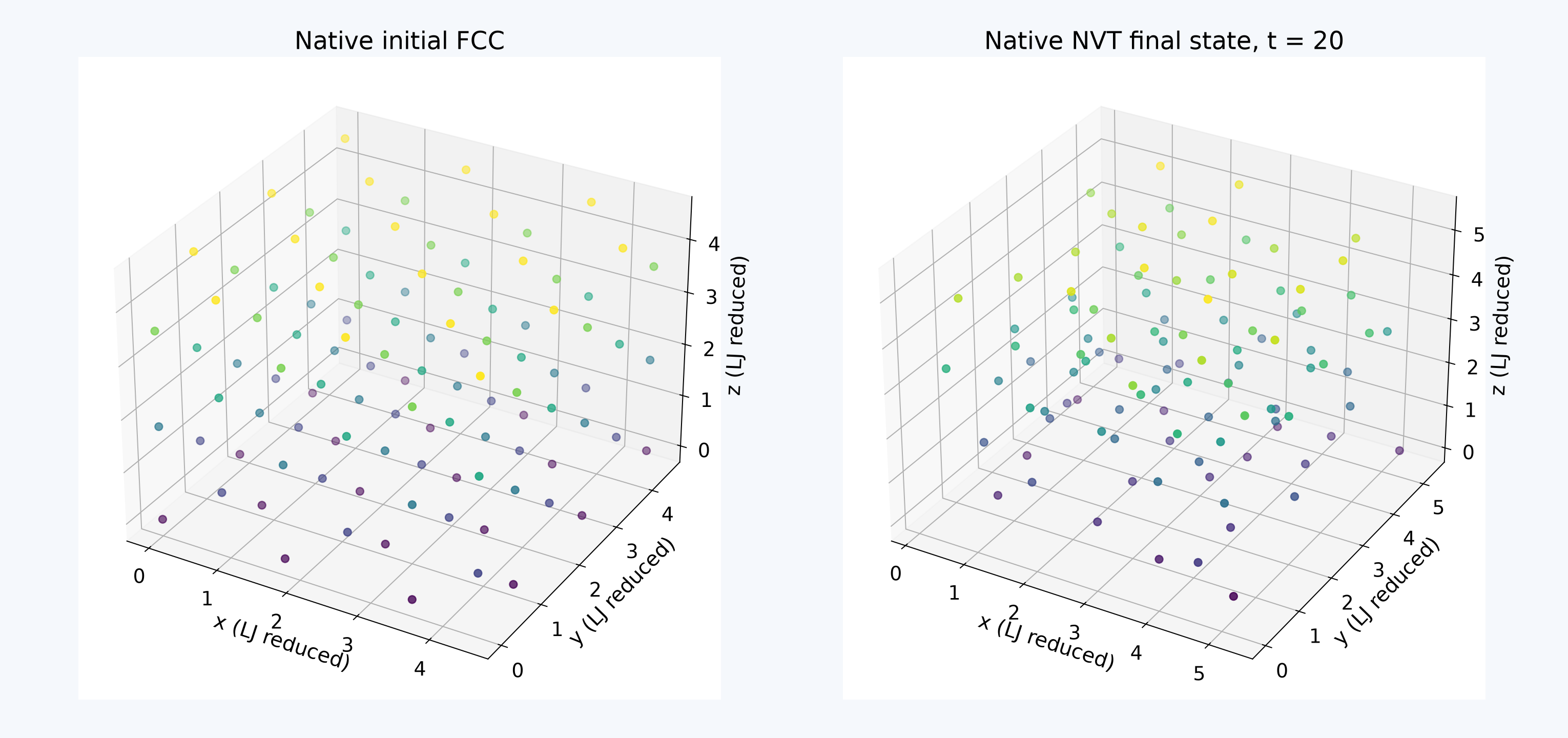
初始结构为3×3×3 FCC晶胞、108粒子,质量1、数密度0.7,初始速度温度1.8;LJ ε=σ=1,截断2.5,势能平移到截断处为零。所有量是LJ约化单位;dt=0.002,每个条件10000步,总时间20。
除NVE外,本篇控温目标为1.0;用时间10—20的数据作操作性均值对照,不作为已收敛的统计物性。初始FCC和末态如下,不从短轨迹判定材料相图。
2. CSVR完整输入:积分器与控温fix分别设置#
inputs/csvr-cpu/in.lammps:
units lj
atom_style atomic
boundary p p p
lattice fcc .7
region box block 0 3 0 3 0 3
create_box 1 box
create_atoms 1 box
mass 1 1
pair_style lj/cut 2.5
pair_coeff * * 1.0 1.0
pair_modify shift yes
neighbor .3 bin
neigh_modify every 1 delay 0 check yes
velocity all create 1.8 20261029 mom yes rot no dist gaussian
fix integrator all nve
fix bath all temp/csvr 1.0 1.0 .2 20261102
timestep .002
thermo 100
thermo_style custom step time temp pe ke etotal press vol density ecouple econserve
thermo_modify norm no format float %.16g
dump trajectory all custom 1000 trajectory.dump id type xu yu zu vx vy vz fx fy fz
dump_modify trajectory sort id format float %.16g
run 10000
unfix integrator
unfix bath
run 0
write_dump all custom physical.dump id type x y z fx fy fz modify sort id format float %.16g
print "PHYSICAL $(pe:%.16g) $(vol:%.16g)" file physical-energy.dat screen no
print "COMPLETE" file complete.dat screen no
fix nve 完成积分,fix temp/csvr 随机重标定速度以控温,二者分工不同。Tdamp=0.2 是LJ时间,不是0.2个时间步;随机种子为20261102。更换为真实体系时按实际units解释阻尼时间。
最后两行 unfix 后的 run 0 只在同一坐标上重算纯势力,没有继续推进MD,便于检查物理力;主MD数据取前面的10000步段。
在已分配资源中单独运行CSVR:
module purge
module load lammps/30Sep2026-p100-gpu
cd inputs/csvr-cpu
lmp -in in.lammps
cd ../..
3. 按目的切换方法#
| 目录 | 关键输入 | 积分方式与用途 |
|---|---|---|
| nve-cpu | fix integrator all nve |
只做积分,温度随动能/势能交换变化 |
| nvt-cpu | fix integrator all nvt temp 1 1 .2 tchain 3 |
Nosé–Hoover链控温,fix本身含积分 |
| nvt-chain1-cpu | fix integrator all nvt temp 1 1 .2 tchain 1 |
单温控自由度的输入对照 |
| langevin-cpu | fix bath all langevin 1 1 .2 20261101 zero yes |
另配NVE;阻尼与随机力,zero yes去掉随机合力 |
| csvr-cpu | fix bath all temp/csvr 1 1 .2 20261102 |
另配NVE;随机全局速度重标定 |
| csld-cpu | fix bath all temp/csld 1 1 .2 20261103 |
另配NVE;随机速度控温方法 |
| berendsen-cpu | fix bath all temp/berendsen 1 1 .2 |
另配NVE;弱耦合温度松弛 |
| rescale-cpu | fix bath all temp/rescale 100 1 1 0 1 |
另配NVE;每100步直接重设温度 |
NVT fix本身已积分,不要再给同一组叠加NVE。其他只提供温控的fix才另配积分器。周期重标定和Berendsen可以帮助理解输入行为、温度松弛;不要把它们当作严格正则系综涨落采样的通用推荐。
4. 从实际轨迹看温度#
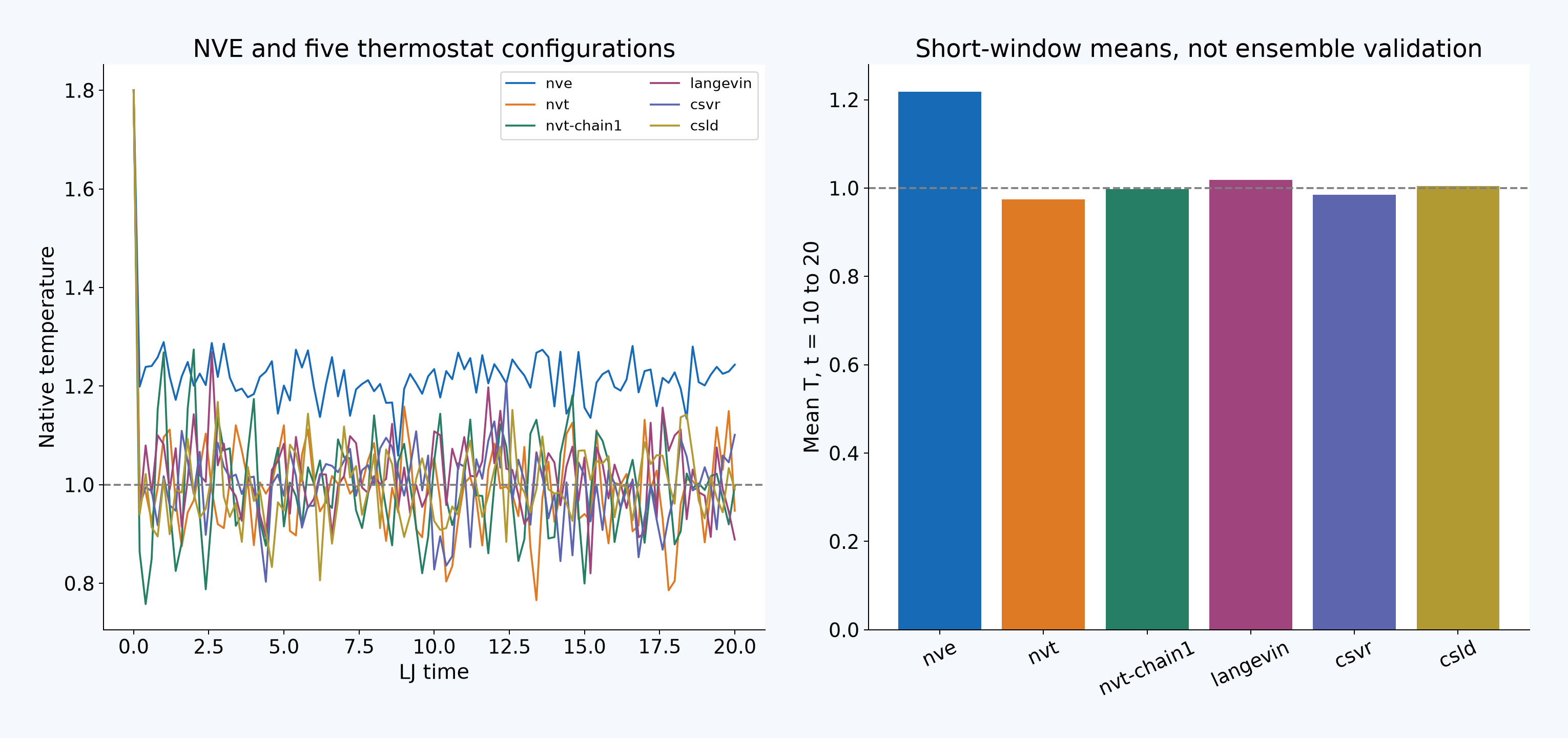
| 方法 | 后半段平均温度 | 后半段温度样本标准差 | 平均数密度 |
|---|---|---|---|
| nve | 1.218517 | 0.037649 | 0.700000 |
| nvt | 0.974608 | 0.089754 | 0.700000 |
| nvt-chain1 | 0.997887 | 0.088275 | 0.700000 |
| langevin | 1.018718 | 0.077544 | 0.700000 |
| csvr | 0.984270 | 0.082526 | 0.700000 |
| csld | 1.005117 | 0.063619 | 0.700000 |
| berendsen | 1.001959 | 0.041054 | 0.700000 |
| rescale | 0.999157 | 0.041021 | 0.700000 |
NVE末态温度不等于初始1.8,本例中部分动能转为势能;这不等于总能量不守恒。CPU、GPU、Kokkos的NVE最大相对总能量变化约1.50×10⁻⁴、1.76×10⁻⁴、1.15×10⁻⁴;仍需通过自己的步长和更长轨迹判断研究所需精度。
表中均值和标准差都来自短窗口。rescale每10步输出,其他方法每100步输出,时间相关和取样间隔不同,不能用表中的标准差给恒温器作“涨落优劣”排序。
5. 周期重标定为什么不能只看重设时刻#
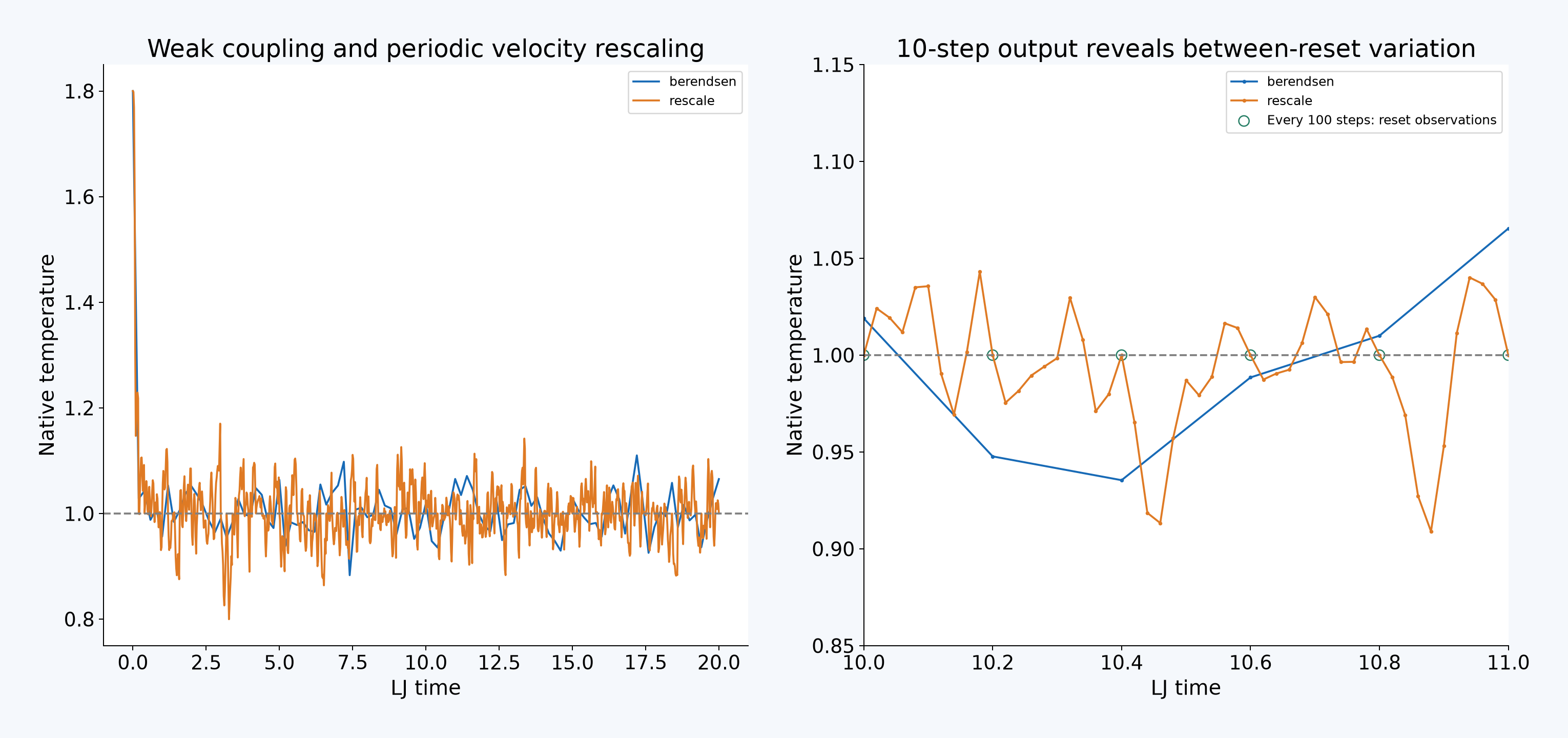
temp/rescale 100 ... 每100步重设温度;如果也每100步打印thermo,看到的恰好都是重设后的T=1,会漏掉期间变化。本例最终输入改为每10步打印,保留两次重设之间的波动。不能据恒定的抽样点声称整段轨迹没有温度变化。
6. 终端提取、导出和画图#
module purge
module load ase/3.29.0
python analyze.py work
python export_states.py work
python plot_results.py work
python check_results.py work
原生输出在 work/cases/,逐时CSV、汇总和含完整周期晶胞的XYZ在 work/analysis/,6张图在 work/figures/。reference/ 是本文实际数据;未重算时,可以把以上 work 改为 reference 重现图表。X为LJ粒子占位符,XYZ坐标、晶胞和 lj_velocity 仍是LJ约化单位,不能直接当成Å、eV或真实元素。
python - <<'PYCODE'
import csv
with open('work/analysis/summary.csv') as f:
    for r in csv.DictReader(f):
        if r['backend'] == 'cpu':
            print(r['method'], r['mean_temperature_last_half'], r['temperature_sd_last_half'])
PYCODE
更换阶段先 unfix 旧积分器/恒温器,再设置新的方法。需要允许晶胞变化时见压控与晶胞,GPU/Kokkos与力精度见后端实操。本例不宣称任意恒温器在任意体系下都能充分遍历正则分布。